
In the digital age in which we are living today, have you thought that technology is going to grow so fast in the coming few years? The AI and automation that we are seeing today in 2026 is just the beginning. In the coming 4-5 years, some such innovative technology will emerge which will change the economy of the entire world.
Today in this article we will talk about “Top 10 Future Technologies that will change the world 2030” which will not only change the way we work but will also change the direction of human history.
Too 5 Future Technologies 2030
- Artificial Intelligence (AI)
- Quantum Computing
- Internet of Things (IoT)
- 6G Technology
- Blockchain Technology
1. Artificial Intelligence (AI)
What is Artificial Intelligence (AI) ?
Artificial Intelligence (AI) is a technology that gives computers and machines the ability to think, understand and take decisions like humans.
The work which earlier took Weeks – Months to complete is now done by AI in a few minutes.
How AI Works?
AI works with the help of data algorithms and learning modes. AI is first given a lot of data, then machine learning algorithms analyse that data and learn patterns and relationships. After this, the neural network and model are trained so that it can understand the new data and take decisions.
Example- When you say “Alexa play a song” to Amazon Alexa, the AI first recognizes your voice, then understands the words and then takes the right action and plays the music. All this happens with the help of speech recognition and AI algorithm.
AI in Daily Life
AI has become a part of our life, whether we are watching YouTube or looking for directions in Google Maps, AI is working. A part from this, there are many such tools and applications in smartphones which do not work without AI.
Challenges and risks of AI
There are many benefits of AI but there are also some risks with it which you need to know. First of all, job loss because due to automation, machines start doing many tasks. Second risk is of privacy and data security because AI system uses a lot of personal data. Apart from this, there is also a risk of wrong decision if AI Training with wrong or incomplete data, as well as “misuse of AI” such as deepfakes or cyber attacks, can also become a big risk.
2. Quantum Computing
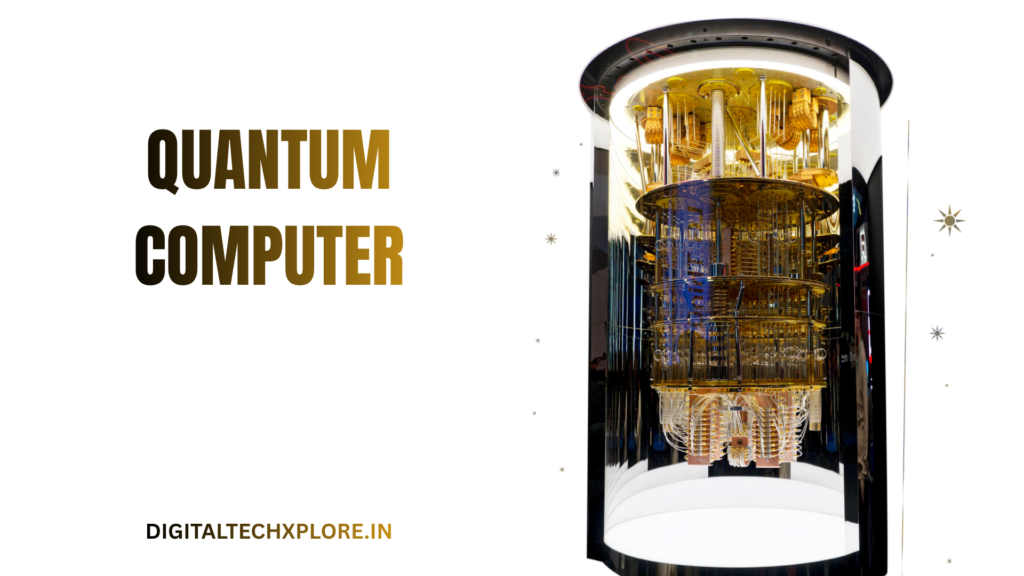
What is Quantum computing?
Quantum computing is an advanced technology that works differently from normal computers. Normal computers use bits 0 – 1 but quantum computers use qubits. The special thing about qubits is that they can be in both 0 or 1 state at the same time, which is called superposition.
How Quantum Computer Works?
Qubits are used to store and process information in quantum computers. Normal computers use bits which are 0 – 1 but due to qubit superposition, they can be both 0 and 1 at the same time. A part from this, there is entanglement between Qubits due to which the state of one Qubit can immediately affect the other Qubit.
With the help of these quantum properties, this computer can do many calculations in a few milliseconds, for this reason, big companies like IBM, Google, Microsoft and others are doing rapid research on this technology.
Benefits of Quantum Computer
Fast Calculation – Quantum computers can solve even the most difficult calculations many times faster than traditional computers
Drug Discovery – The biggest advantage of quantum computer is in the medical field. It can do accurate simulation of the behavior of chemicals and claims at the molecular level, so new medicines and vaccines will be discovered very fast
Optimization in industries – Complex optimization Problem in transport, finance, logistics can be solved quickly
Advanced Scientific Research – Quantum computing will help a lot in making big discoveries in climate modelling, space research and material science.
Cybersecurity – With the help of quantum computers, an encryption system can be created which will be almost impossible to break. This is called Quantum Key Distribution (QKD)
Challenges and Risks of Quantum Computer
There are many challenges and risks associated with quantum computing. The biggest problem is that it is very difficult to build or run and is also expensive because it has to be kept at a very low temperature and social environment needs to be maintained. Apart from this, this technology is not completely stable yet and errors also occur quicklyThere is also a big risk that in the future, quantum computer can break the current encryption system, which can put data security at risk. Also, it requires high level knowledge to understand and use it, hence its widespread use is not easy.
3. Internet of Things (IOT)
What is IOT?
Internet of Things ( IOT) is a system in which many physical devices are connected through the Internet and share data and in this the devices can be controlled smartly and can also be controlled remotely.
How IOT Works?
In IoT, devices like sensors and smart gadgets are connected to the Internet. These devices collect data and send it to the cloud or server, after which the software analyzes the data and takes automatic action when needed or sends information to the user.
Benefits of IOT
Automation – IoT devices can work automatically like smart lights, AC, appliances can turn on/off automatically.
Time savings – Many tasks can be controlled remotely through IoT, which saves a lot of time.
Improved Safety & Security- Smart cameras, alarms and sensors improve home or office security.
Better Efficiency – IoT system collects data and makes the process more efficient such as smart farming or smart factories.
Challenges and Risks of IOT
There are some risks also associated with IoT. The biggest challenge and risk is that of “security” because IoT devices are connected to the network, if there is no proper security, then hackers can steal data or damage the device.
Secondly, data privacy is that IoT devices collect a lot of personal or sensitive data due to which there is a risk of data leakage, apart from this, inter-operability is also a big problem because if the systems are different devices, then it becomes difficult if the systems do not communicate with each other properly and there is a risk of dependency. If any IoT system gets damaged then it can affect the entire service. Keep all this in mind when using IoT.
4. 6G Technology
What is 6G Technology?
Currently we are using 5G technology, now the upcoming technology will be 6G technology which will work at 100 times more speed than 5G.
How 6G Technology Works?
6G technology is a wireless network which will work faster and smarter than 5G. It will use very high frequency (Terahertz) which will transfer data very quickly. In 6G, Artificial Intelligence (AI) network will manage itself so that the signal strength, speed and connectivity.
This technology will become better automatically. This technology will work with the combination of Satellite Towers and connected device IoT which will provide seamless network from everywhere.
Benefits of 6G Technology
Super Fast Speed – The speed of 6G will be almost 100 times faster than 5G, where in 5G it took a few seconds to download a movie, in 6G you will be able to download 50 such movies in one second, its top speed can be up to 1tbps (terabit per second)
Zero latency – Large volumes of data will be sent and received instantly, enhancing real-time applications.
3D Communication – With the help of 6G, the way of video calling will change completely. If you talk to any person through video call, his 3D holographic image will be in front of you. You will be able to see it in your room. It will seem as if that person is sitting in front of you.
Artificial Intelligence(AI) – 6G network is being called AI-Native. This network will automatically identify its shortcomings and fix them. Your smartphones and gadgets will become even smarter with the help of AI.
Everywhere Coverage – You must have wondered that whenever you travel somewhere or go to such a forested and mountainous place where the network is not available at all, but now 6G will be connected to ground towers as well as satellites, which means that no matter where you are in the world, you will get high speed internet.
Expected Launch Date
The Government of India has presented its 6G vision under which India is being prepared to adopt its technology and lead the world by 2030. 6G technology is currently in the research and development stage. According to experts and global organizations, its launch is estimated in 2030.
Challenges and Risks of 6G
6G technology will bring many facilities for us, but some important challenges will also be associated with it. The biggest problem in this is that of high frequency (Terahertz) signals, which have less range and can be easily blocked, hence more infrastructure will be required.
A part from this, having connected devices on such a large scale will increase the risk of cyber security and data privacy, which will increase the possibility of data misuse. More energy will be required to run the 6G network, which can increase power consumption and environmental impact as well as its development Implementation will be very expensive and complex which may cause problems in implementing it globally
5. Blockchain Technology
What is Blockchain Technology?
Blockchain is a technology in which data is stored in blocks and the blocks are connected to each other like a chain. Every block contains transaction information and once the data is stored, it is difficult to change and it is a modern technology that records data or information in this way it becomes almost impossible to change it or hack it or commit fraud. This is called in simple language (Digital ledger) which can be shared simultaneously on the network of thousands of computers around the world.
This technology works without any central authority (like a bank) it is called decentralized system. Cryptocurrencies like Bitcoin are also based on this technology.
How Blockchain Technology Works?
When a transaction takes place, its information reaches many computer nodes in the network. All these computers check and verify that transaction. When the transaction is correct, it is put in a block and then this new block gets connected to the previous block and a chain is formed, in this way every new one data is stored and once added, it is very difficult to change it, hence blockchain is considered secure and trustworthy.
Benefits of Blockchain Technology
High Security – In this, the data is kept safe through hash sport. Once the answer is entered, it is impossible to change or delete it, which eliminates the scope for fraud.
Decentralization – It has no central owner (like the government of a bank), the data is spread across all the computers in the network, which is not at risk of system failure.
Transparency – All transactions that take place on the blockchain are visible to all members and trust remains in this system.
Fast Transaction – Transactions are very fast as there is no bank or third party in between.
Traceability – In works like supply chain, the entire journey of goods from origin to end can be easily tracked.
Challenges and Risks of Blockchain Technology
Although blockchain is considered to be extremely secure, it is also associated with certain issues. The most significant problem is its high cost and energy consumption, as running it requires a powerful computer. Furthermore, speed-related issues sometimes arise during the verification of transactions. Another major threat is the “51% attack,” wherein if a single entity gains control over the majority of the network, the data can be tampered with. If a user compromises their private key, recovering a solution or retrieving their funds becomes nearly impossible. Moreover, blockchain technology is still in its developmental phase; consequently, its rules and regulations are not yet clearly defined across all contexts.
Conclusion
In the coming years, artificial intelligence, the Internet of Things, 6G technology, quantum computers, and blockchain technology will completely transform our lives. All of these technologies will not only make work easier but will also significantly increase speed, security, and connectivity.
While AI will make machines smart, IoT will create smart life by connecting every device to each other. 6G technology will take communication to a new level by providing ultra-fast internet. Quantum computing will solve complex problems in seconds and blockchain technology will make digital transactions more secure and transparent.
However, there are some risks and challenges associated with these technologies such as security issues, high cost and technical complexity, but due to continuous research and innovation, these problems are gradually being solved. By 2030, this technology will completely change the way we work, learn and live.
In the end it can be said that the future will be completely technology driven and only those who adopt these technologies will move forward.